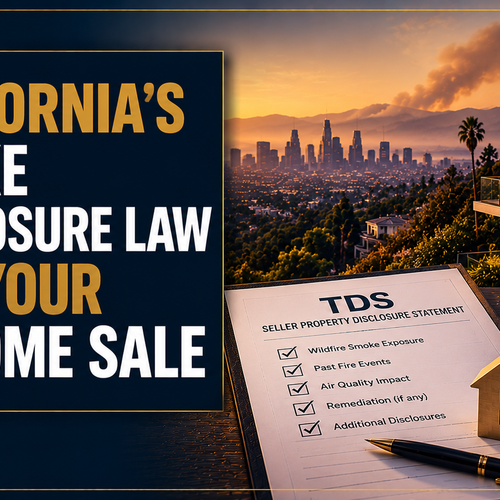

Is California's Zone 0 five-foot defensible space rule in effect yet?
Not yet. The California Board of Forestry and Fire Protection approved the Zone 0 regulations on August 19, 2026, but the package still has to clear the Office of Administrative Law, and the compliance clock for existing homes does not start until CAL FIRE publishes updated defensible space guidance, which has not happened. Once it does, new construction complies immediately, an owner-occupied existing home gets three years or the date of sale, whichever comes first, and a rental gets no runway at all. Separately, California already requires sellers in High and Very High Fire Hazard Severity Zones to disclose combustible landscaping within five feet of the house, and that obligation took effect July 1, 2025.
If you own a hillside house in Los Angeles, you've probably seen a headline saying California just banned plants within five feet of your home. The rule is real and it's most of the way through the process. It is not, as of today, something you can be cited for.
That gap between "approved" and "enforceable" is where most of the confusion lives, and it matters if you're planning to list in the next twelve months. Here's what's actually true.
WHERE THE RULE ACTUALLY STANDS
The California Board of Forestry and Fire Protection approved the Zone 0 regulations on August 19, 2026, by an 8-0 vote. The authorizing statute is AB 1455, chaptered October 13, 2025.
Approval by the Board is not the last step. The package goes to the Office of Administrative Law for review before it becomes part of the California Code of Regulations. As of today there's no published effective date we can point to.
Then there's a second clock. The regulation ties the compliance deadline for existing structures to the date CAL FIRE publishes its updated defensible space guidance document. That guidance doesn't exist yet. Until it's out, nobody can tell you the year you have to be compliant by, and any article giving you a specific date is guessing.
So when you see "you have until 2029," treat it as arithmetic performed on an assumption, not a deadline.
WHAT ZONE 0 WILL REQUIRE
Zone 0 is the area within five feet of each building or structure, or to the property line, whichever comes first. On tight hillside lots with narrow side yards, that property-line clause does a lot of work, and it's the piece most summaries drop.
Inside that five feet, the rule bars landscaping materials likely to be ignited by embers. In practice that means grass, ornamental and native plantings, shrubs, weeds, fallen leaves and needles, dead branches, and combustible mulch or wood chips.
A few things survive:
- Potted plants, if the pot is non-combustible, holds five gallons or less, stands no more than 18 inches tall, and does not sit directly beneath, above, or in front of a window, glass door, or vent.
- Trees taller than the adjacent roof ridgeline, provided they carry no dead or dying branches.
The structural provisions are the ones that cost real money on an LA hillside property:
- The area under decks, balconies, and stairs has to stay clear of vegetation and combustible items. On a cantilevered hillside deck, that is not a weekend of raking.
- Combustible gates cannot be directly adjacent to or attached to the structure.
- A fence attached to the house needs a five-foot non-combustible span at the point of attachment.
- Outbuildings are not permitted in Zone 0 unless they're built entirely of non-combustible materials.
The compliance runway is where sellers need to pay attention, because selling collapses it.
Public Resources Code 4291(g) gives an owner-occupied existing structure three years after the rule applies to new construction, or the date of sale, whichever comes first. A structure used as a rental gets no runway at all: the requirement applies on the same date it applies to new construction. New construction complies from day one.
Read that middle clause again if you're planning to list. The three-year cushion everyone is quoting does not survive your closing.
The rule text the Board worked from layers a second tranche at roughly five years covering under-eave work, combustible gate replacement, and shed and fencing changes. Confirm the final language against the version OAL posts.
WHETHER THIS EVEN APPLIES TO YOU
Zone 0 reaches State Responsibility Areas and Very High Fire Hazard Severity Zones inside Local Responsibility Areas, roughly two million structures statewide. High and Moderate zones inside Local Responsibility Areas are not covered.
For most of our clients, the operative question is whether the property sits in a Very High Fire Hazard Severity Zone in the City of Los Angeles. Outpost Estates does. Much of the Hollywood Hills does, though it varies parcel by parcel and you should check the address rather than the neighborhood.
Two local wrinkles worth knowing, because almost nobody writes about them:
The Sunset Strip is not in the City of Los Angeles. It's West Hollywood, which adopted CAL FIRE's updated zones by ordinance in September 2025. Under the 2025 maps, the Very High zone in West Hollywood expanded south of Sunset Boulevard. If you own there, you're on a different and further-along track than your neighbors over the city line.
The City of Los Angeles has not confirmed adoption of CAL FIRE's 2025 maps. CAL FIRE released the updated Southern California Local Responsibility Area maps in March 2025, and LAFD said it was working to align them to city streets and parcel lines. We found no adoption ordinance. The municipal code still points to a map adopted in 2011.
The practical consequence: the state's recommended map and the City's legally adopted map may disagree about your parcel. Check both. The state viewer at experience.arcgis.com will search by address, and LAFD publishes its own fire zone map. If the two disagree, call LAFD before you spend money on landscaping.
THE PART THAT ALREADY APPLIES TO YOU
Here's what gets buried under the Zone 0 headlines, and it's the piece that actually touches your sale.
California already requires two fire disclosures at sale in High and Very High Fire Hazard Severity Zones, and they sit in different code sections.
Civil Code 1102.19 is the defensible space one. Since July 1, 2021, a seller has had to give the buyer documentation of compliance with defensible space requirements, or the parties can agree in writing that the buyer will obtain compliance within one year of the sale.
Civil Code 1102.6f is the one that reaches the five-foot band, and it applies if the home was built before January 1, 2010. Since January 1, 2021 it has required the seller to disclose known vulnerabilities, and the statutory list names combustible landscaping or other materials within five feet of the home and under the footprint of any attached deck. A separate component, fire-hardening retrofit information drawn from the State Fire Marshal's low-cost retrofit list, became operative July 1, 2025.
Read that again. If your house predates 2010 and sits in a High or Very High zone, the five-foot band is already a disclosure item on your sale, today, whether or not Zone 0 has cleared OAL. Buyers' agents in the hillside markets are asking about it, and a seller who hasn't thought about it is answering the question live at the kitchen table.
This is exactly the kind of thing we'd rather handle in the pre-listing conversation than in escrow, and it pairs directly with the broader question of what fire hardening actually costs an LA homeowner.
Clearing the five feet also helps on the insurance side, though it does not buy you a policy.
The Department of Insurance's Safer from Wildfires framework lists a five-foot ember-resistant zone among the mitigation actions that qualify for a discount. Two caveats the state states plainly: discounts vary by carrier, and you have to prove you did the work. Expect to provide documentation or sit for an inspection.
Nothing in the regulation or the statute makes compliance a guarantee that a carrier will write you, renew you, or price you better. Given how tight the hillside market has been for coverage, we'd treat Zone 0 work as removing an objection rather than winning an approval.
Enforcement, when it arrives, leans on education first. In the City of Los Angeles, inspection runs through LAFD's existing Brush Clearance Program. No Zone 0-specific penalty schedule has been published.
WHAT WE'D DO IF YOU'RE LISTING IN THE NEXT YEAR
Pull your parcel on both maps. Walk the five feet with a contractor and price the deck underside, any attached wood fencing, and any shed sitting inside the zone, because those are the line items that carry real cost. Then decide whether you're doing the work or disclosing it and letting the buyer price it.
Both are defensible positions. The one that hurts is discovering it during the buyer's inspection.
FREQUENTLY ASKED QUESTIONS
Can I be fined right now for having plants within five feet of my house?
Not under Zone 0. The Board of Forestry approved the regulations on August 19, 2026, but they still need Office of Administrative Law review, and no Zone 0 penalty schedule has been published. Existing defensible space requirements under Public Resources Code 4291 and LAFD's Brush Clearance Program continue to apply on their own terms.
How do I find out if my Los Angeles home is in a Very High Fire Hazard Severity Zone?
Search your address on the state's fire hazard severity zone viewer, then check LAFD's own fire zone map, because the City has not confirmed adoption of CAL FIRE's 2025 maps and the two can disagree. If they conflict for your parcel, contact LAFD directly before making decisions based on either one.
Does Zone 0 mean I have to remove trees near my house?
Not necessarily. Trees taller than the adjacent roof ridgeline may remain if they carry no dead or dying branches. What comes out is the ember-catching material at ground level: grass, shrubs, combustible mulch, weeds, and accumulated leaves and needles within the five-foot band.
Do I have to disclose combustible landscaping when I sell my LA hillside home?
Yes, if the home was built before January 1, 2010. Under Civil Code 1102.6f, sellers in High and Very High Fire Hazard Severity Zones have had to disclose known vulnerabilities since January 1, 2021, and the statutory list names combustible landscaping or other materials within five feet of the home and under the footprint of any attached deck. Talk to your agent about how you're handling it before the property goes live.
Will clearing Zone 0 get me a home insurance discount?
It can. The Department of Insurance's Safer from Wildfires framework includes a five-foot ember-resistant zone as a qualifying mitigation, but discounts differ by carrier and you'll need proof of the work or an inspection. No rule makes compliance a guarantee of coverage, renewal, or a lower rate.
Zone 0 isn't enforceable yet, but the five-foot band around your house is already something you disclose when you sell, and pricing the work before you list is cheaper than negotiating it in escrow. If you'd like the same kind of market read we share with our clients every month, sign up for Real Brief, our monthly insights into the LA luxury real estate market, delivered straight to your inbox.
Alexis Ramos and Luke Abbott are the founders of Ramos & Abbott Homes, a luxury real estate team with Sotheby's International Realty in Beverly Hills. Together they specialize in architectural and historic homes, new construction, and income properties across West Hollywood, Sunset Strip, Hancock Park, Hollywood Hills, Beverly Hills, Melrose District, Fairfax District, Sunset Square, and Spaulding Square.
Check out this article next